 Deutsch
 English
 Español
Personal branding with AI: turn expertise into trust
Make your contribution clear, show evidence people can assess and use AI with your own judgement. A practical guide with a three-minute check and a seven-day plan.

Contents
- What personal branding means when anyone can publish
- Start with a problem you can describe precisely
- Make your expertise possible to check
- Use AI to sharpen your thinking and your writing
- Give your website, LinkedIn and search a clear job
- Your three-minute personal branding check
- A seven-day plan with something useful to show each day
- Why I wrote Personal Branding Expert
- Questions about building your personal brand with AI

Lukas Günther Teissl
Certified IT Expert
AI, IT consulting, automation & business optimisation
- 15+ years of experience
- 65+ IT certifications
- German, English, Spanish & Italian
- [email protected]
Imagine you are choosing between two consultants with comparable skills. One promises innovative solutions, excellence and transformation. The other explains the problem they solve, shows a relevant example and tells you what an initial conversation would cover. You still need to assess both. But the second has already made that assessment easier.
Your expertise deserves the same clarity. People who have never worked with you cannot see everything you know. They need a way to understand your contribution and decide whether to trust it. This guide shows you how to make that possible, use AI thoughtfully and take a practical first step with Personal Branding Expert, my book on positioning, credibility and personal visibility.
What personal branding means when anyone can publish
Personal branding is the deliberate work of making your expertise, approach and contribution understandable and credible. Your reputation develops through what you do, what others experience and the evidence they can find. Visibility gives people an opportunity to encounter that reputation. It cannot establish the truth of a claim on its own.
A useful personal branding strategy connects three questions: what should people come to you for, why should they believe you can help, and how can they explore that possibility? Followers and polished photographs tell you little about whether those questions have been answered.
AI makes your judgement more important
AI can generate fluent explanations and plausible suggestions. Your distinctive contribution comes from the decisions you can explain: why you chose one approach, what you learned, where it failed and what you would change. Documenting that judgement gives readers something concrete to examine.
You can be recognisable without sharing every part of your private life. A clear professional focus, a consistent tone and an honest account of how you work give personality a useful place in your communication.
Start with a problem you can describe precisely
Choose a situation your intended reader already recognises. “Digital transformation” covers an enormous territory. “Customer enquiries get lost between the shared inbox and the service team” describes a problem someone can discuss. Your first task is to connect your expertise to that situation.
Write a working sentence: “I help [specific people] address [recognisable problem] through [your actual contribution]. We begin by [a realistic first step].” Then place one relevant example beside it. A positioning sentence becomes useful when a reader can follow the connection between your promise and your work.
A hypothetical consultant: from broad promise to clear contribution
Assume an IT consultant has the experience described below. This hypothetical example describes no real client project or commercial result.
Before: “I deliver innovative digital solutions for ambitious businesses.”
After: “I help small service businesses organise customer enquiries so responsibilities and next steps are visible. I combine process mapping with software implementation. Our first conversation looks at how an enquiry moves through your team today.”
The revised version identifies a reader, a practical task and a starting point. The consultant could support it with an approved workflow example, explaining their own role and its limitations. The improvement is clarity; whether a project follows depends on the actual need and fit.
Make your expertise possible to check
Choose one claim from your profile and ask what would let another person assess it. “Experienced in automation” becomes more informative when accompanied by a specific decision, a demonstration or an explanation of the work involved. For this article, use four prompts:
- Context: What was the situation, and what constraints mattered?
- Contribution: What did you personally do, and what belonged to others?
- Evidence: What can you show, link to or explain with permission?
- Limits: What does this example establish, and what remains unknown?
A useful example might be an annotated process diagram, a public demonstration or a technical article explaining a trade-off. If you cannot publish client work, prepare a clearly labelled demonstration. Give the reader enough context to distinguish a demonstration from a completed client assignment.
Google's guidance on helpful content asks creators to consider clear sourcing, demonstrable expertise and information about the author. Apply that principle to your own claims: let people trace the basis for your statements.
Use AI to sharpen your thinking and your writing
Begin with material that belongs to you: notes from a task, a question you hear regularly, an approved example and your explanation of a decision. Give AI a defined editing job. Ask it to identify jargon, organise an answer or compare different introductions.
Remove confidential details before using a tool, and use only material you are entitled to share in that setting. Here is a practical prompt you can adapt:
Help me explain my work to [audience]. Use only the facts in these notes: [approved notes]. Draft three positioning statements, each under 50 words. Name the audience, the problem and my contribution. Do not add clients, qualifications, results or numbers. Flag missing information. Then list the claims I need to verify and any wording that sounds generic.
Review the output in three passes. First, match every factual claim to your notes. Second, check whether your intended reader would understand it. Third, read it aloud and replace phrasing you would never use in a conversation. A polished sentence that overstates your role needs correcting.
Google's guidance on generative AI content stresses accuracy, quality and relevance, including manual review before publication. Treat the prompt as a starting point for your judgement. Your review gives the result its professional value.
Give your website, LinkedIn and search a clear job
You do not need to build every channel at once. Choose a place where people can understand your offer in depth, and a place where you can contribute regularly to relevant conversations.
Your website: a coherent account of your work
Connect your positioning, examples, author information and contact route. Link a useful article to the relevant service or book page. Someone arriving through one question should be able to understand who wrote the answer and what they can explore next.
LinkedIn: professional context and conversation
Make your headline and introduction agree with your website. Share an answer to a real question, explain a decision or discuss a useful limitation. Choose a publishing rhythm you can sustain. Replying thoughtfully to one relevant discussion can be a sensible task for a week when you have little time.
Google and AI search: useful answers with clear context
Write descriptive headings, answer the question directly and show the basis for factual claims. Google's guidance for its generative search features continues to emphasise useful original content and established SEO practices. It does not require special AI markup, and appearance in search remains unguaranteed.
To assess business relevance, look beyond impressions: do enquiries mention the problem you address, does your evidence answer initial questions, and are the conversations appropriate to your offer? Visibility can lead to interest, scrutiny, contact and a possible collaboration. Each stage needs its own clear next step. For the wider commercial context, read personal branding, revenue optimisation and working online.
Your three-minute personal branding check
Open your website or main professional profile. Answer yes only when a visitor can find the answer there.
- Can a new visitor understand my specialism and the problem I help address?
- Can my intended reader recognise who my work is for and why it is relevant?
- Is there at least one traceable example that supports a claim about my expertise?
- Do my website and profile communicate a consistent focus, with key content easy to find?
- Is there a clear, appropriate next step for someone interested in my work?
Count one point per yes, up to five. This is a reflection exercise, with no scientific or diagnostic claim. Each no identifies a concrete improvement. If you answer yes to all five, ask someone from your intended audience to repeat the check and explain what they understood.
A seven-day plan with something useful to show each day
Keep the scope small: one audience, one problem and one useful piece of evidence. These are complementary exercises developed for this guide.
Day 1: Choose a real question
Write down a question a prospective client or colleague has actually asked. Describe who asks it, when it matters and what they need to decide.
Day 2: Write your positioning
Use the sentence above. Replace broad claims with a task you can explain. Keep only work you can credibly offer.
Day 3: Document one example
Use context, contribution, evidence and limits. Confirm permission to publish. If needed, create and label a demonstration using fictional data.
Day 4: Align your website and profile
Check your introduction, headline and contact links. Make the same professional focus recognisable across both, using wording appropriate to each.
Day 5: Prepare one helpful answer
Answer the question from day one. Ask AI to review structure or clarity, then verify the facts and restore your own voice.
Day 6: Ask a reader and test the next step
Show the page to someone from your intended audience. Ask what you help with and what they would do next. Try the contact route yourself.
Day 7: Revise and set a review date
Fix the clearest misunderstanding. Record what changed and choose one useful follow-up. Revisit the check in a month with fresh evidence.
Watch for four avoidable problems: addressing everybody, publishing interchangeable AI text, making claims without support and starting more channels than you can maintain. Use the week to improve one complete path from first impression to a meaningful next step.
Why I wrote Personal Branding Expert
I have been developing my own brand for more than 15 years. My work in IT and digital systems, alongside travel and international collaboration, has shaped my interest in how people understand each other and establish trust. I wrote Personal Branding Expert to connect that experience with clear communication and the practical possibilities of AI.
The official book presentation describes positioning, credible evidence of expertise, AI support for content and visibility with a clear next step. The cover introduces the Lukas-Teissl Method through positioning, demonstrating expertise, digital visibility and professional opportunities. Those are the themes presented here; the exercises in this article provide an additional starting point.
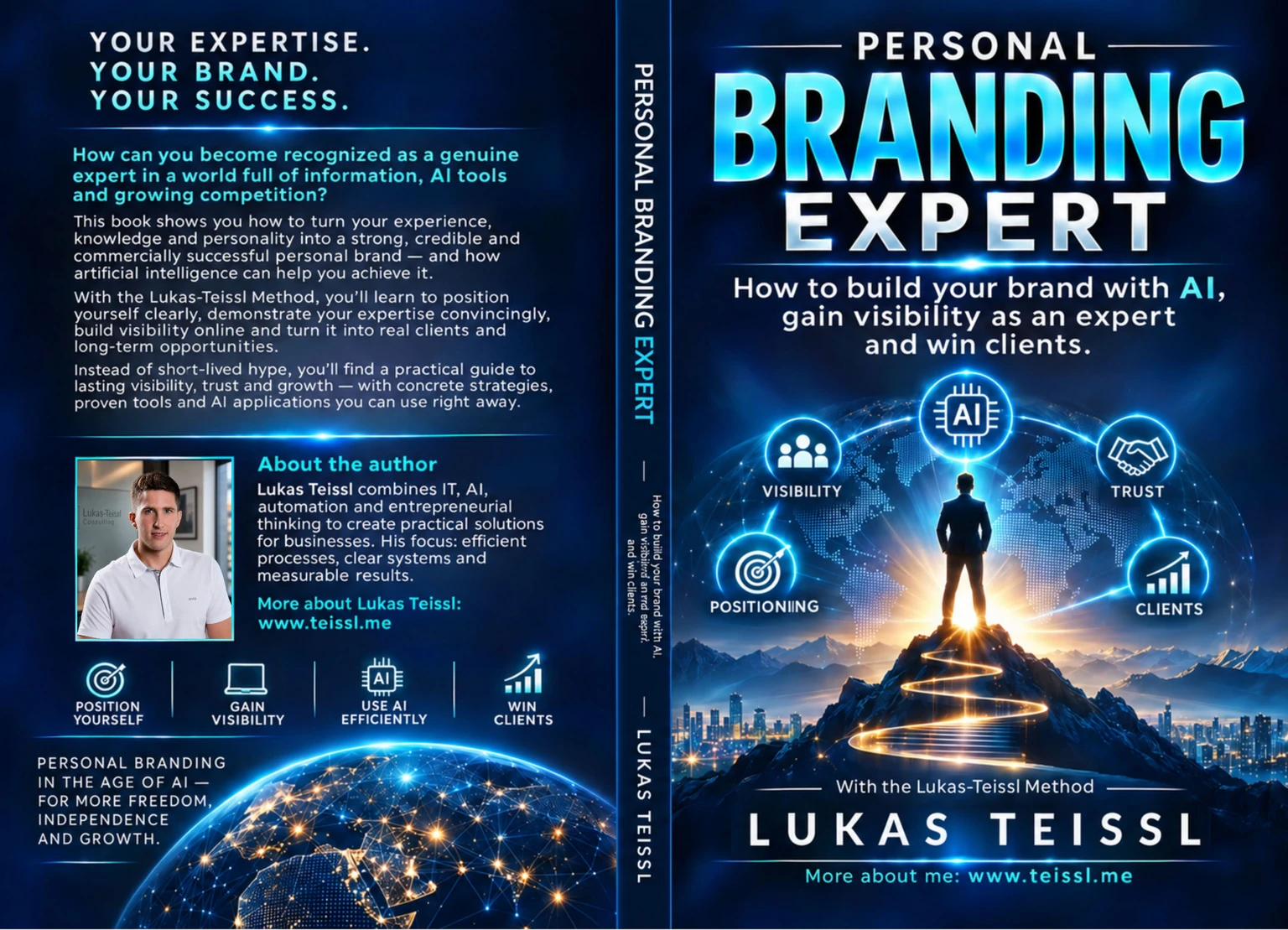
The book is relevant if your knowledge and personality are central to your work: as a freelancer, consultant, founder, specialist or leader. Use the book page to decide whether its emphasis matches your current needs. You can explore the German edition, the Spanish edition and all four of my books. You can also explore my background and the published references on this website.
Direct order · Search Amazon by title and author
Check the language, edition, price and availability with the provider before ordering.
Questions about building your personal brand with AI
Do I need a large audience to begin?
You can begin with a small professional network. Choose a specific audience, answer a relevant question and make your contribution understandable. The self-check helps you identify what needs attention.
Can I build a personal brand without sharing private details?
Yes. You can communicate your judgement through useful writing, demonstrations and professional conversations. Decide which experiences belong in public and keep a boundary you feel comfortable maintaining.
What should I leave to AI?
Give it bounded tasks such as organising approved notes or identifying jargon. Keep responsibility for facts, permissions, professional conclusions and the final wording.
Is this useful for employed specialists and leaders?
A clear professional profile can help you explain your contribution beyond your immediate team. Respect your organisation's rules and agree what work, information or examples you can publish.
How quickly should I expect commercial results?
There is no dependable timetable or guaranteed outcome. The seven-day plan is designed to improve clarity and evidence. Evaluate relevant conversations over time alongside your offer, market and capacity.
Where can I explore or order the book?
The official book page presents the English edition, the cover, language options and ordering routes. The Amazon title search uses the book title and author; check the edition and supplier details.
Sources & further information
- Personal Branding Expert: official book page and complete coverLukas Guenther Teissl · Accessed: November 12, 2026View original source
Source for the stated book themes, the cover's description of the Lukas-Teissl Method, author background, editions and existing ordering links.
- Books by Lukas TeisslLukas Guenther Teissl · Accessed: November 12, 2026View original source
The author's stated motivation and the relationship between personal branding, IT, AI, travel and the four books.
- Creating helpful, reliable, people-first contentGoogle Search Central · Accessed: November 12, 2026View original source
Guidance on original value, clear sources, demonstrable expertise and information about the author.
- Google Search's guidance on using generative AI content on your websiteGoogle Search Central · Accessed: November 12, 2026View original source
Accuracy, quality, relevance and manual review of AI-assisted content before publication.
- Optimizing your website for generative AI features on Google SearchGoogle Search Central · Accessed: November 12, 2026View original source
Established SEO practices and useful original content remain relevant to generative search; special AI markup is not required and search appearance is not guaranteed.
Turn your expertise into a clearer personal brand
Choose one claim, find its evidence and make it clear. Explore Personal Branding Expert to see how its approach fits your next step.

Lukas Günther Teissl
Lukas Günther Teissl combines long-standing IT experience, system development and structured business analysis. The knowledge centre explains technical and strategic relationships clearly, practically and without unnecessary simplification.